prompts
positive prompts
- The thoughtlessness of Humankind, and the loss of Nature as it was intended is the focus, referring in particular to humanity’s decline. To include the destruction of the Rival, or rather the Vitriol of the Rival, who rebelling from the Creator, and by gathering many Conspirators, was driven out by the Creator into the great Unknown.
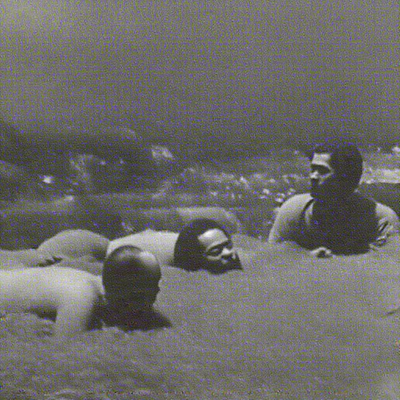
- Here the Rival and his Conspirators lying on the burning Lake, shocked and overwhelmed, begin to orientate themselves. The Rival calls to a Conspirator next in Rank and File closest to him and they discuss their terrible fall.
negative prompt
monster, fantasy, sci-fi, extra people, poorly drawn, extra limb, floating limbs, airbrush, photoshop, plastic doll, cropped, out of frame, worst quality, low quality, jpeg artefacts, duplicate, extra fingers, poorly drawn face, extra limbs, cloned face, extra arms, too many fingers, caricature, facebook, youtube, food, lowres, text, error, poorly drawn hands, blurry, extra legs, username, watermark, signature
word substitutes
Original
Substitute
Man
Humankind/ Humans
Paradise
Nature
Satan
Adversary/ Rival/ Antagonist/ Apostate/ Missile/ Sun/ Volatile
Serpent
Venom/ Violence/ Dissent/ Warhead/ Gas/ Vitriol (poss. Poison/Snake)
his
its
God
Creator
Angels
Crew/ Conspirators
Heaven
Unknown/ Home
the great Deep
Abyss
locally run ComfyUI: https://www.comfy.org
FLUX.1-dev: https://flux1ai.com/dev
image & prompt_1
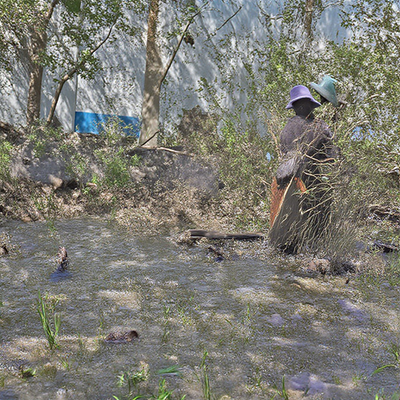
image & prompt_2
summary
These images are a selection from Ilia’s test using the following combination, two adapted versions of Paradise Lost extracts based on my research on word substitutes to try and avoid the generation of stereotypical, overly polished religious imagery, his negative prompt, and a set of 77 unlabelled photos. The images use different random seeds (a random number that kick starts the generation process).
The test outcome illustrates that AI image generators do not pull from or “connect” to a photo library in the way a search engine does. This generative process, rather than a retrieval‑based one, may explain why there is a disconnect between the prompts and the final output.
The general conclusion Ilia came to is that Stable Diffusion 3.5 fails to deliver an image with necessary nuance and quality. All tests suffered from AI sheen and other typical problems. As soon as he switched to FLUX.1-dev, we started noticing more interesting and varied results.
The test outcome shows that some poses resembled the library images, and this was because there were few outputs from multiple training steps. To increase compensation for a smaller dataset some light image modifications were inserted into the training pipeline. One of them was a random rotation of the image, from -15 to 15 degrees. The black borders on the second image is a product of having these augmentations and overtraining the LoRA model. Prompts 1 and 2 produced stereotypical, overly polished religious imagery — an aesthetic I aimed to avoid.
This test was part of the exploration to show AI’s representational limits and its bias toward oversimplification, grotesqueness, or artificial perfection.





 Karren Visser