Paradise Lost,
Book 1
extracts used to influence
positive prompts
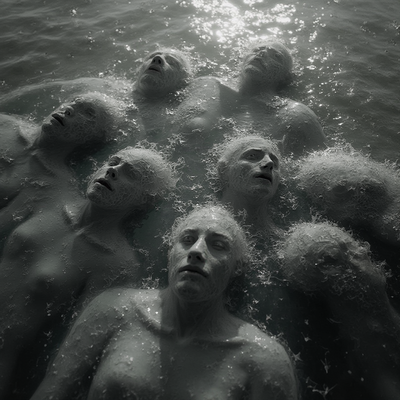
” … Angels lying on the burning Lake, thunder-struck and astonisht …” [The Argument]
workflow checkpoint: flux1-dev-fp8.safetensors
LoRA: flux-lora-collection / realism_lora_comfy_converted.safetensors
ComfyUI_00309
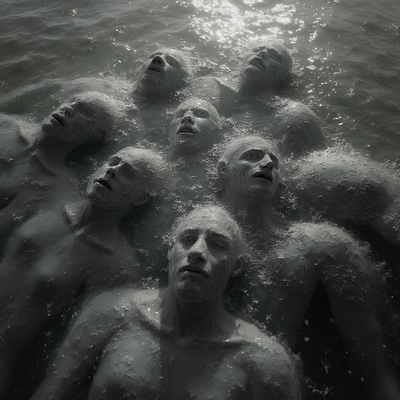
ComfyUI_00292
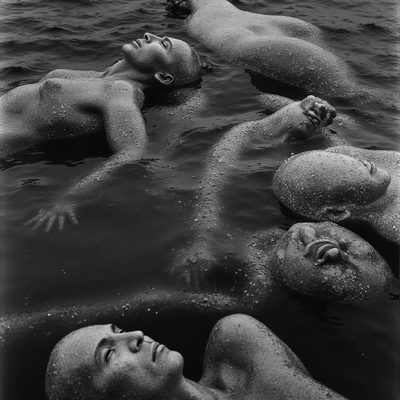
Ilia’s Low-Rank Adaptation (LoRA) model trained on a dataset of 77 photographs
ParadiseUnseen_00005
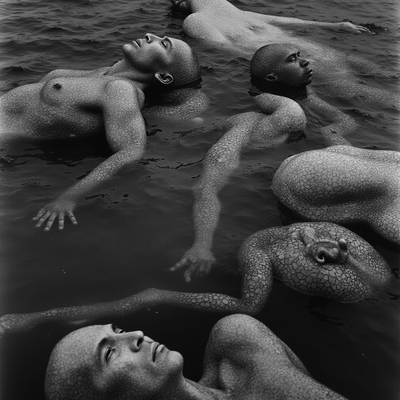
ParadiseUnseen_00004
summary
This selection presents my attempts at generating images inspired by my visualisation of “angels lying on the burning lake.” A fixation on depicting water that appeared to be on fire initially drew me to experiment with Midjourney at the start of my research. However, I found its outputs limited in detail and overly saturated in colour — a key reason for choosing to generate black-and-white images in both tests from 21/08/2025 and 25/08/2025.
In this series, the word “humans” produced more detailed results than “people,” unlike in 21/08/2025 tests. I again applied photographic framing techniques to influence composition, expanding on the use of “closeup” in 21/08/2025 by adding “angle from above”.
From my experiments with FLUX.1-dev and Ilia’s model to convey the idea of “floating,” I learned that base AI image generation models are primarily trained on depictions of people standing or sitting rather than lying supine or prone. This explains the frequent distortions and deformations in the generated figures — also visible in the falling forms of results from 21/08/2025.
Addressing AI bias requires not only greater diversity in the representation of minority groups, age, and gender, but also in poses and expressions. As a photographer experiencing progressive sight loss, I believe this lack of diversity has a significant impact on how people are portrayed — and ultimately, how we are all seen!





 Karren Visser