Paradise Unseen began with an interest in the seventeenth‑century English poet John Milton having composed his epic Paradise Lost after going blind. The haptic quality of the verse gives the imagery an immediacy that I can relate to as touch is central to the way I navigate my surroundings. This awareness helped me to piece together elements of the poem using a similar approach to how I build up what I cannot see due to degenerative myopia.
I wondered whether quotations from Paradise Lost with their vivid details and references to a wide range of sources could be used to make photographs. Imagine, audio description determining the visual image and not the other way round! The pragmatist in me thought, you can’t set fire to a lake or encourage others to fall from dizzying heights and languish in flames for your creative benefit. Not wishing to give up, I decided to explore Midjourney image generator. The results were lurid kitsch.
A combination of a close‑up view of the world and the way I photograph made me question what influences the massive datasets. Crucially, who is responsible for making up the billions of image and text pairs used by AI image generators? The more I understood that the AI image generator model is a way to adapt a large machine model for specific uses without retraining the entire model, the more I felt like I was in Milton’s “utter darkness”. Except mine was far from poetic!
I am indebted to Wojciech Wolocznik for his patience and willingness to work with me in establishing the checkpoints to begin training a model. Our findings resulted in more questions than answers. Why did the text prompts tested with a selection of AI image generators result in similar outcomes even though the styles they promote are different? And why were these images often unrelated to the text prompts?
While Wojciech and I struggled with establishing the checkpoints for model training, I started to build a small photo library relevant to Book 1 of Paradise Lost. This raised questions about whose photographs I could choose and how I would feel if mine were being used for such a purpose. My selection was influenced by a contemporary interpretation of the Renaissance poem in the hope that the images generated would attract a diverse audience. What struck me was the lack of disability representation in AI‑generated images. Was this an oversight by those involved in making up the billions of image and text pairs used by AI image generators?
Stuck with unresolved workflows from checkpoint tests, and unable to find a computer scientist who could assist me in model building, I was close to giving up. Wojciech encouraged me to persevere and use this preliminary research for an Immersive Arts Explore funding application. Despite not having secured the vital technological expertise to make this work, I was encouraged to apply for funding from Tom Godfrey, Director of Bonington Gallery, Nottingham Trent University. Tom knows of my interest in making visual art accessible to blind and visually impaired people. Professor Hugh Adlington, Department of English Literature, University of Birmingham, a Milton scholar, agreed to meet online and expressed his interest in my way of seeing Paradise Lost.
Often challenging the ocularcentrism of visual art, fundraiser Matthew Cock, supported me in the application process. Unlimited agreed to assist me in inviting disabled artists to share their self‑portraits for the building of a photo library. Like my initial approach to building a library, the intention is for quotations from Paradise Lost Book 1 to be embedded in short descriptions of the photographs and a selection of the generated images to have audio descriptions. This is to ensure the findings from this collaborative project reach a diverse audience.
I have been awarded Explore £5k funding from Immersive Arts. Paradise Unseen is one of 83 artist‑led projects out of 2517 applications across the UK to be allocated a share of £1.2 million in the first round of Immersive Arts funding – a scheme supporting artists of all backgrounds and experience to work with immersive technologies.
Paradise Unseen is dedicated to photographer and curator Douglas McCulloh, who sadly died in January this year. In our last conversation when we spoke of the exhibition he had curated, Every Day We Have to Invent the Reality of This World: AI Post Photography at the California Museum of Photography, Doug offered me a perspective I hadn’t considered: “Dwell less on your lack of technical expertise, instead focus on exploring self-representation and claiming the power to challenge AI bias.” In keeping with the Doug’s advice, I am looking for a computer scientist who can assist with model building, someone who may be further down the track with the joys and pitfalls of AI text‑to‑image generation than me and interested in an unusual creative exploration. See the preliminary work and tests in the Paradise Unseen research overview.
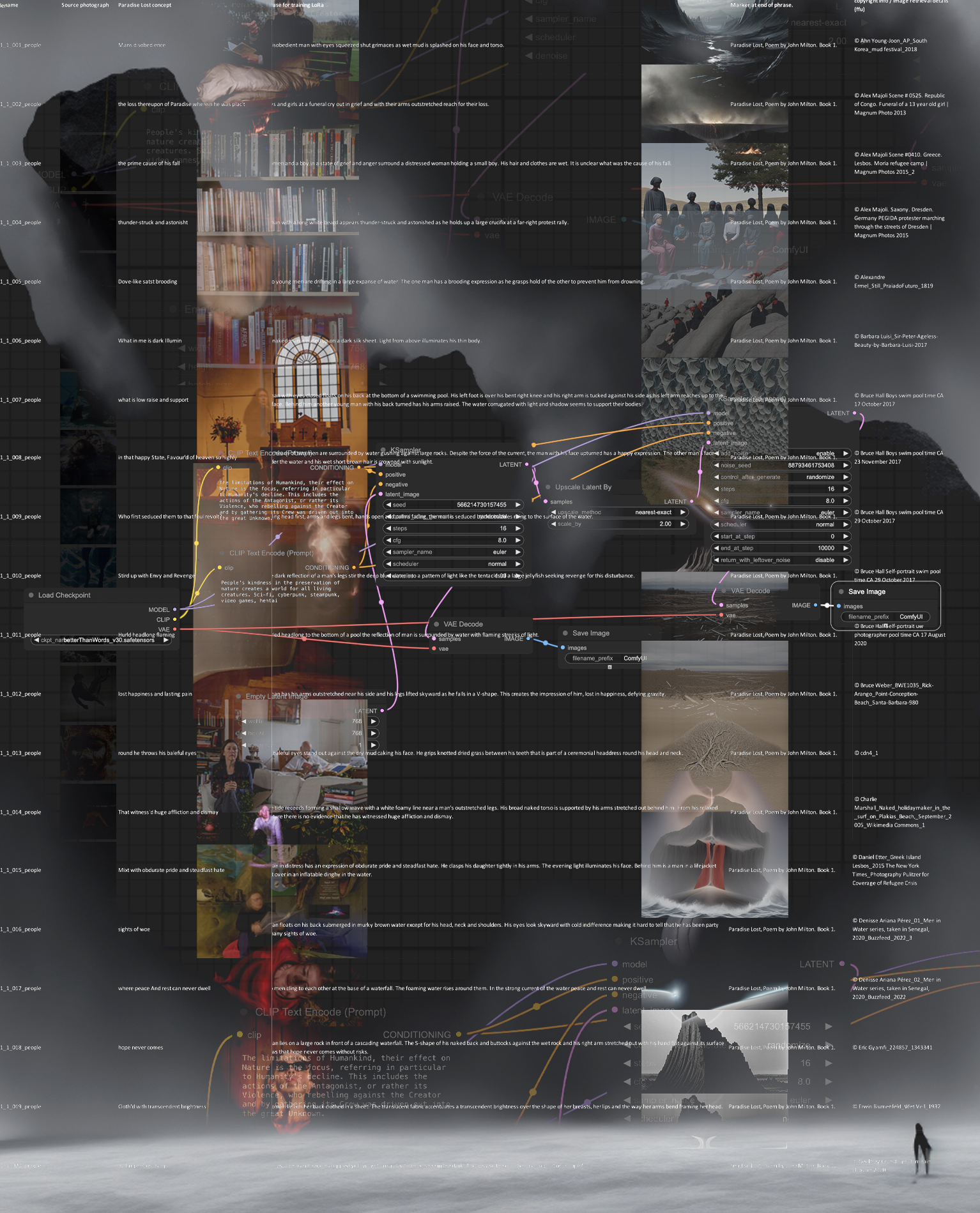
See the preliminary work and tests in the Paradise Unseen research overview.

An Access to Work grant from Department of Work and Pensions supported the design of this webpage.
© Karren Visser. Paradise Unseen, funded by Immersive Arts UK, 2023 – 25.
 Karren Visser